1. Q1 Financial Performance: Defying the Law of Large NumbersWhen Palantir reported its Q1 earnings, the market was stunned by the shear magnitude of its growth. For a mature software enterprise generating billions in annual revenue, accelerating top-line growth at this scale is an anomaly in the technology sector. - Record Revenue: Q1 revenue hit $1.633 billion, representing a 85% Year-over-Year (YoY) increase.
- Accelerating Growth Trajectory: This marked the highest single-quarter growth rate in Palantir's history and the 11th consecutive quarter of accelerated growth.
- Breaking Industry Norms: Standard corporate lifecycle theory dictates that growth decelerates as revenue base expands. Palantir has reversed this curve—growing faster as it grows larger.
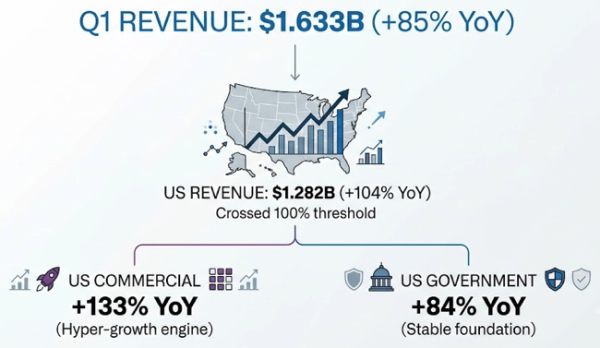
2. Sector Deep Dive: Rewriting the Corporate NarrativePalantir has historically been categorized as a niche software vendor heavily reliant on military and government contracts. The Q1 sector breakdown indicates a structural shift toward private enterprise dominance. US Market Dominance- Total US Revenue: Reached $1.282 billion (+104% YoY), crossing the 100% YoY threshold for the first time since its public listing.
Commercial vs. Defense Growth- US Commercial Sector (+133% YoY): The primary driver of revenue acceleration. Private enterprises are rapidly adopting Palantir’s infrastructure to modernize operations.
- US Government Sector (+84% YoY): Maintains robust growth, providing a defensive cash-flow baseline while the commercial arm scales aggressively.
- Strategic Pivot: The commercial segment is now expanding at a significantly faster rate than defense contracts, dismantling the narrative that Palantir is solely a government contractor.
3. The Key Catalyst: AIP (Artificial Intelligence Platform)The driver behind this explosive expansion is Palantir’s Artificial Intelligence Platform (AIP). Palantir’s competitive positioning differs fundamentally from conventional software vendors selling generative AI utilities. "Palantir does not sell 'AI slop'—superficial chatbot wrappers or useless AI outputs. We sell real operational operating systems powered by enterprise AI."
— Alex Karp, CEO of Palantir
Key Differentiators of AIP:- Operational Integration: Rather than offering stand-alone large language model (LLM) interfaces, AIP embeds AI agents directly into complex business operations.
- Enterprise Governance & Security: Provides built-in data governance, strict permission controls, audit capabilities, and cost tracking.
- Value Realization: Transitions enterprise clients from preliminary AI experimentation ("We tested AI") to measurable economic value ("AI optimizes our business logistics").
4. Q2 Earnings Preview & Critical Focus AreasFor the upcoming Q2 earnings release, market expectations are positioned around high growth metrics. Key Guidance & Benchmarks- Q2 Revenue Guidance: $1.797 billion to $1.801 billion.
- Target Growth Rate: The upper bound of guidance translates to approximately 90% YoY growth.
- Full-Year US Commercial Target: Set at $3.224 billion+ (representing >120% YoY growth).
Primary Metrics to Watch- US Commercial Growth Continuity: The critical indicator is whether the US Commercial division can sustain a growth rate near or above 130%.
- Guidance Revisions: Investors will assess whether management raises full-year targets again, confirming the long-term runway of AIP adoption.
5. Moat Analysis & Valuation OutlookUnderstanding Palantir’s premium valuation requires evaluating customer stickiness and product architecture. 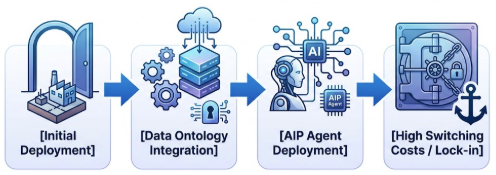
Why Customers Remain Retained:- Ontology Integration: Palantir builds a digital twin (ontology) of an organization's entire operational data flow. Once embedded, replacing this infrastructure carries massive operational risks and switching costs.
- Expansion via Bootcamps: Palantir's AIP Bootcamps enable prospective clients to build functional enterprise workflows in days rather than months, rapidly shortening sales cycles.
- Valuation Justification: High net retention rates combined with accelerating commercial adoption justify higher price-to-sales (P/S) multiples compared to traditional SaaS peers.
Summary ConclusionIf Palantir validates that its Q1 acceleration was not a single-quarter outlier but a sustainable trend driven by AIP enterprise integration, the Q2 earnings release could serve as a major catalyst for continuing its upward stock trajectory. |